

New directions amid a variety of histories
Well before Trinity Lutheran Church came into being, German Lutherans in Pennsylvania had conducted their worship in their native language — and they weren't all alike. The Pietists were among the earliest German Lutherans to come to the Philadelphia region. Among them was the mystic Johannes Kelpius, the "Hermit of the Wissahickon," who set up his small community along the Wissahickon Creek west of Germantown in 1694.
The Pietists believed in living daily according to scripture. The earliest leaned more greatly on prophecy than on rationalist theology, but they taught the Bible and Christian living in their communities, and they likely were the first to conduct German Lutheran worship services of any kind in what is now northwest Philadelphia.
More orthodox Lutheran immigrants settled after 1725, and around 1727 a group organized St. Michael's Lutheran Church in Germantown, which was not yet part of the city of Philadelphia. It's with this congregation that Trinity's story began.
An "American" Lutheran congregation

By the early 1800s, many second- and third-generation Lutherans in the village of Germantown were no longer familiar with the German language. Young people especially wanted services in English.
This was in line with the spirit of the Reformation: Martin Luther had translated the Bible into German so laypeople could read and understand it. It also reflected the shock of encounters with German and other immigrants in the young United States who were against religion altogether. A revivalist religious movement was surfacing among American Lutherans — a less mystical version of Pietism.
The St. Michael's congregation had grown significantly, and within it were those with more Pietist leanings for whom worship and biblical education in English were particularly important. Although the church had shifted to offering some services in English along with the German ones, these "American" Lutherans had other conflicts within the congregation, including over women's right to vote in church matters — which the St. Michael's orthodox members did not support.
Finally, a group of members seceded in 1836, organizing under the name English Evangelical Lutheran Church in Germantown. Thus it became one of the few solely English-language Lutheran churches in the Philadelphia area at the time; another was the African American congregation of St. Paul's, under the Reverend Jehu Jones.

The Sauer House in the 1950s
Connection to Christopher Sauer (1695–1758)
In September 1836, the trustees of this new church purchased the land on which Trinity Lutheran Church stands today. Germantown was still largely rural, and the tract contained only one building, formerly the home of the Bullock family, built on the foundations of a building owned by Christoph Sauer and his son.
Sauer was the first German-language printer and publisher in North America and the first to publish the Bible on this continent in any European language. This 1743 "Sauer Bible" followed Martin Luther's translation and achieved great success among the Amish, Brethren, and Anabaptists of Pennsylvania, especially. Subsequent editions were published in 1763 and 1776 by his son Christopher, who took over the printing business.
The younger Sauer permitted German immigrant Jacob Bay to establish his business in the building: what became first successful American typefoundry. Bay purchased the property in 1779 and lived there until 1783, and eventually it was purchased by Joseph Bullock, who constructed the present building.
As the new congregation developed, the building became the church's parsonage and gradually was known simply as the Sauer House.
Expansion and renaming
The cornerstone for the new church was laid in May 1837, and the building was dedicated in December. It was a simple one-story building that could accommodate a congregation of 100 or so, with plain wooden furnishings.
From the earliest days, the congregation opened itself to the Germantown community, allowing use of the building by singing societies, temperance meetings, public lectures, and benefits. The congregation established a Sunday school and eventually a small library from which students could borrow books.
The new church financed itself not only through member giving but through the sale of burial plots in its growing cemetery; highly successful fairs and events, often organized by the women of the church; and pew rentals. Pews were rented not only to communing members to reserve preferred spaces but to anyone who wanted and could afford a "presence" in a church — often for political reasons.
Ongoing space challenges, especially for the Sunday school, eventually led to the decision to build a new church building. The cornerstone for today's Trinity Lutheran Church main church building was laid in October 1856, and the steeple spire, modeled after those of British architect Christopher Wren, was raised in June 1857.

The congregation dedicated its new church building in October 1857. At the same time, it officially changed the name to Trinity Lutheran Church, Germantown.
One of the earliest additions to the new building was Germantown's first town clock, installed by December 1858. It served as Germantown's only town clock for 20 years, marking the hours in an era when personal watches were uncommon.
In the Civil War years of 1861–1865, Trinity granted use of the church to the Field Hospital Association for fundraising lectures to support wounded Union soldiers. Lutheran congregations in Pennsylvania, including Trinity, were widely urged to provide blankets winter clothing support for those engaged in fighting.
Trinity was also known for its Sunday school and its literary societies, especially the Trinity Lyceum, which numbered in the hundreds. Fundraising efforts by these entities, private donations, and the usual offerings and social events enabled the church to renovate and, finally, to pay off its mortgage — though not without hard times along the way.

Trinity as seen from Germantown Avenue in the 1930s
One hundred years of ministry and growth

Trinity Parish House ca. 1936
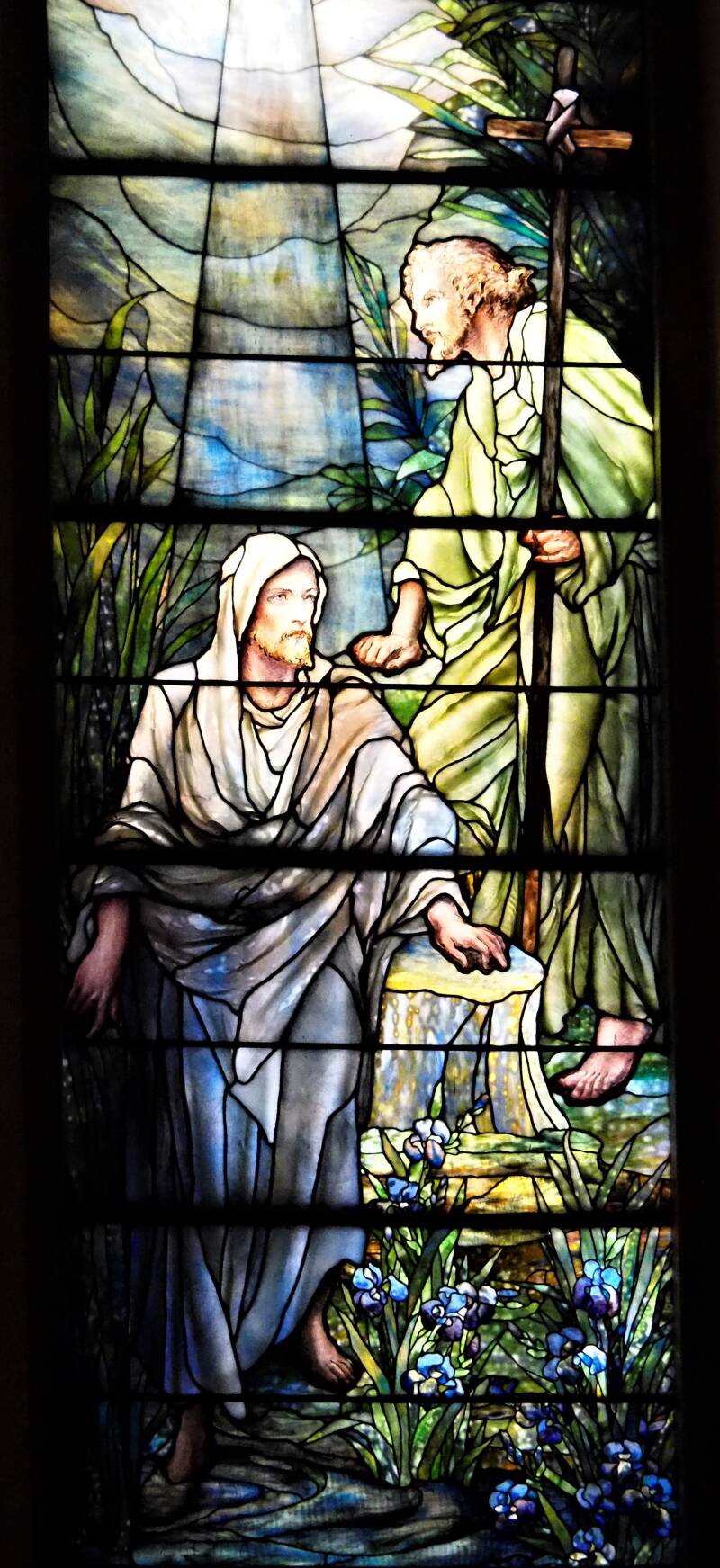
The Baptism of Christ Tiffany Memorial Window
By 1908, Trinity Lutheran Church was steadily growing and debt-free. It was also home to many societies, of which the Women's Auxiliary, the Men's Club, and the Women's Home and Foreign Missionary Society were most prominent. Adult Bible classes drew more members from the community, and weekday religious instruction was instituted for afterschool.
This growth in programming, especially the activities of the Men's Club, motivated the congregation to add a parish house addition to the main church building, the cornerstone of which was laid in spring of 1915. Trinity dedicated the completed building in October. Through the generosity of a distinguished member, bowling alleys, shuffleboard, showers, lockers, and other equipment were installed in the basement.
This period saw considerable remodeling in the upper church sanctuary, or the auditorium as it then was called, and installation of a number of memorials, chief among them the marble altar (1911) and the Tiffany window of the baptism of Christ (1916). The latter is a descendant's tribute to Swedish Lutheran pioneer Charles Christopherson Springer (1658–1738), who on a visit to London was abducted to Virginia and compelled to work as an indentured servant on a plantation. He later went to the Swedish settlements in Delaware, where he can be found in the records of Holy Trinity Church (Old Swedes) in Wilmington.
Progress in both ministry and building renovations was interrupted by the US entry into World War I in 1917. At least 70 men from families associated with Trinity served, three of whom died in the war. Due to a wartime shortage of coal, the church building was closed for a period in 1918, and services relocated to the Parish House.
The postwar years saw a gradual regrouping of congregational activities and the formation of Boy Scouts troops among the organizations associated with the church. In the summer of 1928, the upper sanctuary underwent considerable redecoration with the addition of a marble floor for the chancel, elevating the altar; choir stalls; and a new organ.
Also installed were a series of eight windows depicting the life of Christ, designed by the studio of Italian-born stained-glass artist Nicola D'Ascenzo, himself a resident of Germantown. (D'Ascenzo's work may also be seen in Princeton University's chapel, Riverside Church in New York, Washington Memorial Chapel at Valley Forge, and the National Cathedral in Washington, DC, among many other sites.) The first two windows, depicting the Nativity and the ministry of Jesus, were dedicated in 1929. Two additional windows, of Moses and of the prophet Elijah, grace the narthex.
Through prudent management and considerable congregational activity, Trinity was able not only to weather the financial ravages of the Great Depression but to assist with local relief. In 1936, Trinity Lutheran Church joyfully and fruitfully celebrated its centennial with over six days of celebratory activities.
The times, they are a-changing
In 1979, Dr. Edward T. Horn III, pastor of Trinity Lutheran Church over 1946–1977, noted: "In 1946, members had belonged to Trinity for an average of 22 years; in 1976, less than 7 years!" In the post-World War II era, the Germantown neighborhood shifted from one of long-established families and businesses to a booming but much more transient population.
Neighborhood growth and social changes are reflected in some of Trinity's activities. The church added Sunday services in 1946 to accommodate "overflow," which continued through the 1980s. In 1947, Trinity established a canteen to bring young people off the streets Saturday nights, which ran for 16 years. The congregation launched a nursery school in 1953, which ran to the 1970s, and a social worker was added to the staff full time in 1954.
In the building, the congregation added air conditioning to the chapel in 1955, and over the course of the next decade, a parking lot, an elevator, a Parish Hall kitchen, parlor space, and choir rooms emerged on the property.
Trinity opened its facilities to community organizations for meetings — sometimes as many as 30 groups a year. In 1958, communing membership peaked at 1,403. The first nonwhite member joined in 1954 and the first Black member in 1962.

Trinity Lutheran Church ca. 1979
Broadcasts of Trinity's 1954 Easter service and 1976 Colonial Service alerted many in the wider region to the church's history and worship and the quality of its music. In 1970, the congregation added a contemporary service that continued for a decade. Another high point came at the 150-year celebration, when horse-drawn carriages bore the pastors to church.
Over this time too, formation of a Friendship Group for over-60s and increased cooperative efforts with other Lutheran churches in northwest Philadelphia, especially through the Northwest Parish based at Trinity in the 1970s, pointed to churches' struggles to attract and retain younger generations amid ever greater distractions.
The community also experienced "white flight" — white wealth abandoning Germantown for suburban locations and an increase of nonwhite residents long challenged in or restricted from accumulating wealth. As the church grew interracially, it experienced a decline in revenue, though seldom from a lack of generosity or desire.
Responding to these changes, Trinity instituted its Day Care Program, which ran from the 1970s into the 1990s, when it was supplanted by Head Start. Several of Trinity's current membership came to the church through working with or having children in these programs.
A considerable hit to the church's membership occurred with the Lutheran Church in America's 1988 merger into the ELCA and the removal of all its departments to Chicago. Since the early 1960s, the neighborhood had housed the LCA's publications board, Christian education department, and liturgical vestment supply. Many Trinity members into the 1980s were LCA staff. At the merger, a significant number relocated to the new offices in the Midwest, while even more took retirement and moved out of the neighborhood.

The Trinity Cemetery on Queen Lane ca. 1965
We've come this far by faith

2007 Rejoicing Spirits Picnic at Trinity

Trinity Young People Spell Out the Church's Name at 175th Anniversary
As Trinity entered the 21st century, the congregation marked another milestone when it called the Reverend Barbara Berry-Bailey as the first Black pastor and first woman pastor to lead the congregation. Over her tenure, the church introduced jazz vespers and revived the churchwide international Hunger Appeal emphasis.
Trinity also became a worship site for Rejoicing Spirits, a program in collaboration with KenCrest, in which the congregation hosted joyous worship services for intellectually and developmentally challenged adults. Trinity members delighted in interacting with the worshipers and their assistants for many years.
The innovation of a Lay Preachers Academy under the vice-pastorship of the Reverend Rosa Key in 2004 allowed lay members to expand in the priesthood of all believers and deliver their insights into Scripture many Sundays. It also relieved some of the church's financial challenges in handling salary. The program continues today, and a new lay preacher is in training.
Camp Belief, a half-day Saturday religious camp, for years ministered to both children and their families in the "regular season," providing Christian activities while offering their families both some time to rest and Bible study, if desired. Members' also remained committed to sustaining a summer week of Vacation Bible School up to around 2010.
In 2011, Trinity celebrated 175 years of life and ministry with a well-attended anniversary service and dinner.
Throughout the 2000s, a constant has been Trinity's November Women's Day program, which has gathered the women of Trinity and friends and family in joyful celebration of the efforts of women in Christian mission and ministry.
As it did all churches, the covid-19 pandemic impacted on Trinity's congregation significantly, challenging members to learn new computer skills to maintain not merely worship but the relationships, traditions, and connection to place involved in being a community. Even masked, Trinity managed to hold one flea market in 2020, along with property cleanups and Zoom services.
The vibrancy of Trinity's "Welcome Place" has always lain in its Christian mission and its dedicated membership. Even amid struggles, with the grace of God and the warmth, commitment, and wholehearted faith of Trinity's leaders, the congregation has piloted a faithful course forward.
As a former history of Trinity put it:
Rich as its history may be, the true glory of Trinity Church is in the privilege of continuing to bear
witness to Christ in its community today.... The open doors of its buildings and the open hearts of
its people convey an invitation and warmth of welcome to all.
For history up to 1936, Trinity is deeply indebted to the work of Edward W. Hocker, historian and genealogist, in his work History of Trinity Lutheran Church, 1836–1936.